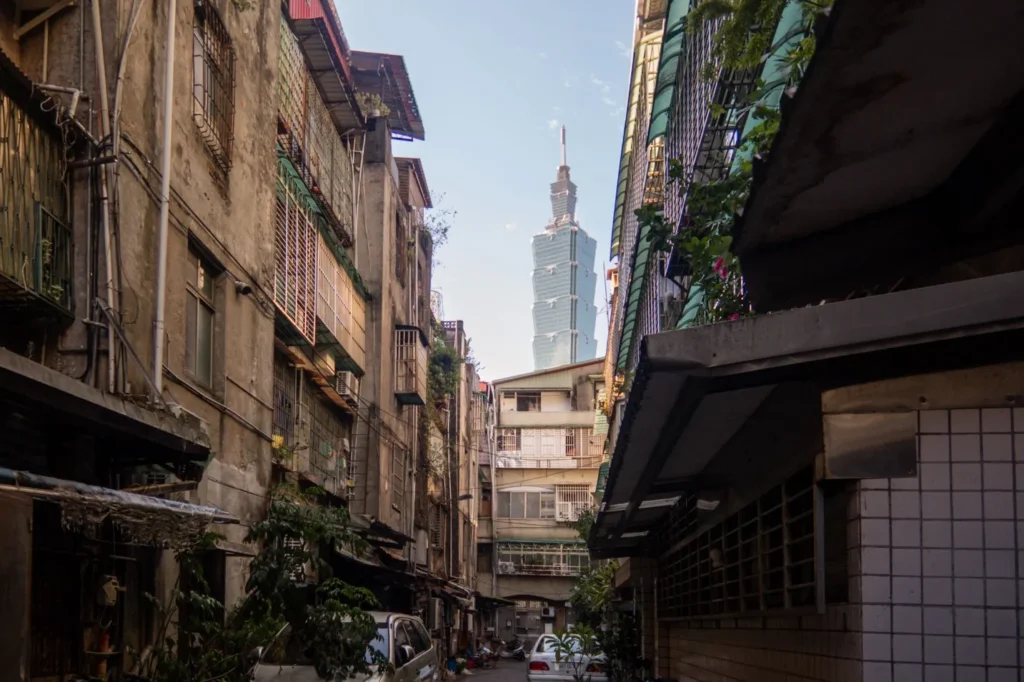
T A I W A N
travel guide
90% of my time in Taiwan I was drenched in sweat. The other 10% was rain and the occasional splash of oil from a bubbling stinky tofu stand. The humidity was relentless, I had an electric fan basically glued to one hand, and an umbrella in the other.
Usually, this type of weather would ruin a trip for me. But when you’re getting lost in Taipei’s smoky night markets, cycling past Chishang’s rice fields, exploring the ancient streets of Tainan or soaking in the coastal views of Taitung, none of it really matters. You’re completely in the moment. You’re in Taiwan.
Visiting Taiwan is special. It doesn’t get as much attention as its neighbors China, Japan and Korea, so at times it can feel like you’ve been given early access into the next “must-visit” destination. And make no mistake, Taiwan deserves a spot on that list.
The four things to sort before you fly.
Travel insurance
Nobody buys travel insurance with any enthusiasm, and almost everyone wishes they had at some point, usually around the moment a scooter scrape becomes a hospital visit, or a delayed flight wipes out a non-refundable hotel. Two providers cover almost everyone reading this.
True Traveller
If you hold an EU passport, True Traveller is the most sensibly priced option I’ve found. EU-only as a product, but covers you anywhere in the world. They’ll also let you buy cover after you’ve already left home, which most insurers refuse to do.
Get a quote →World Nomads
For travellers from outside the EU, and for anyone planning a longer trip with the usual mix of hiking, scooters and ill-advised cliff-jumping, World Nomads remains the standard. Adventure activities most insurers won’t touch, and you can extend your cover from the road.
Get a quote →An eSIM, sorted before takeoff
Taiwan has fast, cheap, ubiquitous data, and the cleanest move now is to load an eSIM onto your phone before you fly. You’ll be online the moment you land. No fumbling with a physical SIM, no airport kiosk queue, no haggling in a language you don’t speak.
Airalo
Pay-as-you-go data on a Taiwan plan, around US$4 for 1GB and US$19 for unlimited across 5 days. Install the eSIM through their app a few minutes before takeoff. The standard for short trips and light users.
Get a plan →Visa (probably nothing to do)
Taiwan grants 90-day visa-free entry to passport holders from the UK, the EU, the US, Canada, Australia, New Zealand, Japan, South Korea and most of Western Europe. You don’t need to apply for anything in advance. Just turn up with a valid passport (six months of validity left) and proof of an onward flight, and you’re waved through. Worth a quick check on the Bureau of Consular Affairs site for your specific passport before you fly.
A card that doesn’t punish you abroad
Cities are largely cashless, but night markets, smaller towns and the east coast still run on cash. The clean setup is a fee-free travel card like Wise or Revolut for ATM withdrawals and contactless payments. Pull out NT$3,000 to NT$5,000 (US$100 to US$160) on arrival and you’ll be set for a few days. Tipping doesn’t exist, so you’ll never need to round up.
Is Taiwan Different To China?
Many people group Taiwan and China together, regarding Taiwan as part of China. However, once you actually visit Taiwan, the differences are obvious almost immediately. Taiwan feels completely distinct, politically, culturally, and socially.
For starters, Taiwan uses Traditional Chinese characters, while mainland China uses Simplified Chinese. But the differences go far beyond language. Taiwan has its own government, its own democratically elected president, its own currency, military and passport, and has operated separately from mainland China since 1949, when the losing side of the Chinese Civil War fled to the island and established the Republic of China government here.
Taiwan feels open, laid-back and incredibly welcoming. Conversations feel freer, the internet is unrestricted, and there’s a strong sense of individuality here that feels very different from mainland China. In 2019, Taiwan became the first place in Asia to legalize same-sex marriage which reflects how progressive much of Taiwanese society is today.
Don’t casually refer to Taiwan as “part of China” when talking to locals. Taiwan’s political identity is deeply personal and complicated, and many Taiwanese people strongly identify as Taiwanese, not Chinese. It’s best to approach the topic with a bit of awareness and respect.
The things no one tells you
1
An umbrella is the ultimate accessory
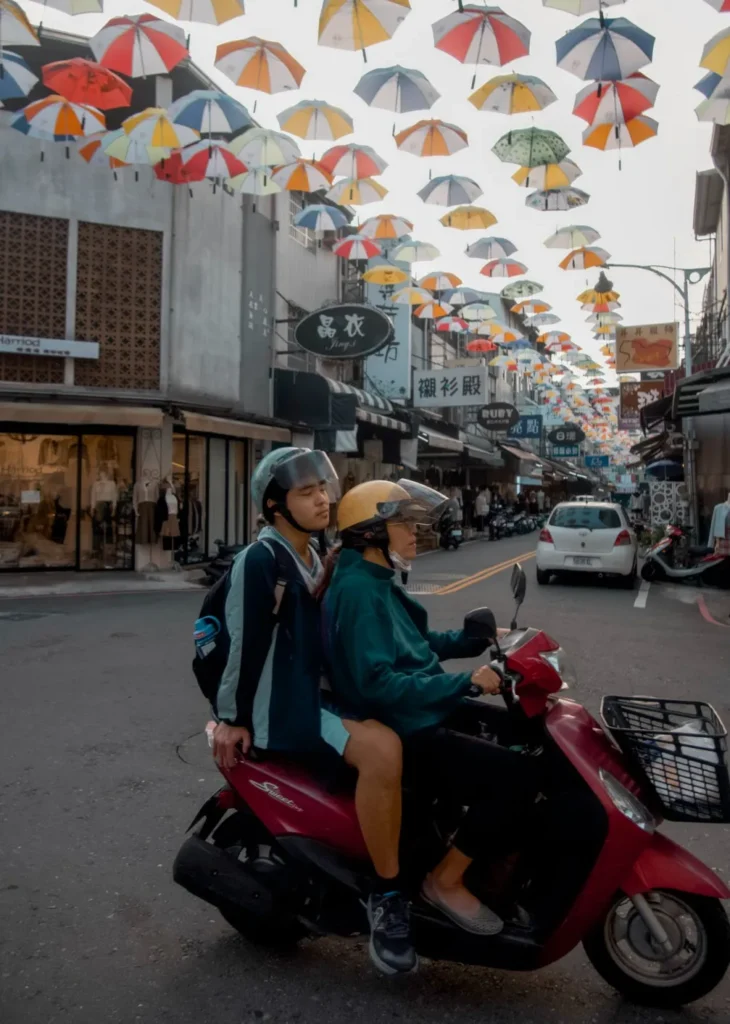
Carry a small umbrella at all times, if it’s not to protect you from heavy rain showers then the strong UV rays. You’ll find lots of cool umbrella shops around Taipei with cute designs.
2
Stand on the right of escalators
Right side is for standing, left is for walking. The whole country runs on this rule. Block the left and you’ll get a polite tap on the shoulder, or a less polite glare.
3
Hydration
It gets super hot and you can’t help but sweat. Pocari is a good alternative to water, it helps replace the electrolytes you’ve lost from sweating. Aside from purchasing water in the shop, you can save yourself a few dollars by filling up your bottles at water stations. Download the Feng Cha app to find a water station near you.
4
Don’t tip. Anywhere.
Tipping isn’t part of the culture. Not at restaurants, not in taxis, not at hotels. Upmarket places sometimes add a 10% service charge, but that’s the only time you’ll see it. Leaving extra causes more confusion than gratitude.
5
Mondays…
Many cafes, restaurants and museums are closed on Monday.
6
Listen for the trash truck
Most apartments don’t have communal bins. When you hear the trash truck rolling down your street playing Beethoven’s “Für Elise” on loop, that’s your cue to grab your bag and chase it down. Miss it and you’re hoarding a week of rubbish.
7
Treat temples like libraries
Step over the raised wooden threshold at the entrance, never on it. Keep your voice down inside, and don’t photograph anyone in the middle of praying. Most temples are free, deeply atmospheric, and worth a quiet half hour.
How To Get Around Taiwan
The public transport in Taiwan is some of the best I’ve used in Asia. The first thing to do when you land is grab an EasyCard from any MRT station or convenience store, it works on the metro, local buses, the high-speed rail (HSR), some trains (TRA), and even pays for snacks at 7-Eleven. It costs NT$100, there is no preloaded amount, you just top it up at ticket machines or 7-Eleven, then tap on and off. It really is easy (excuse the pun). You can also get an EasyCard keychain from convenience stores, they act as the card does but come in a range of cute designs like a Pokeball, shopping bag, and donut. It’s also a cool souvenir.
Remember to get a refund on any leftover amount on your EasyCard. You can do this at information desks in MRT stations, Taoyuan Airport MRT service booth. You can receive a refund up to NT$1,000. There is also a handling fee of NT$20 handling fee. I recommend only topping up by NT$1,000 at a time
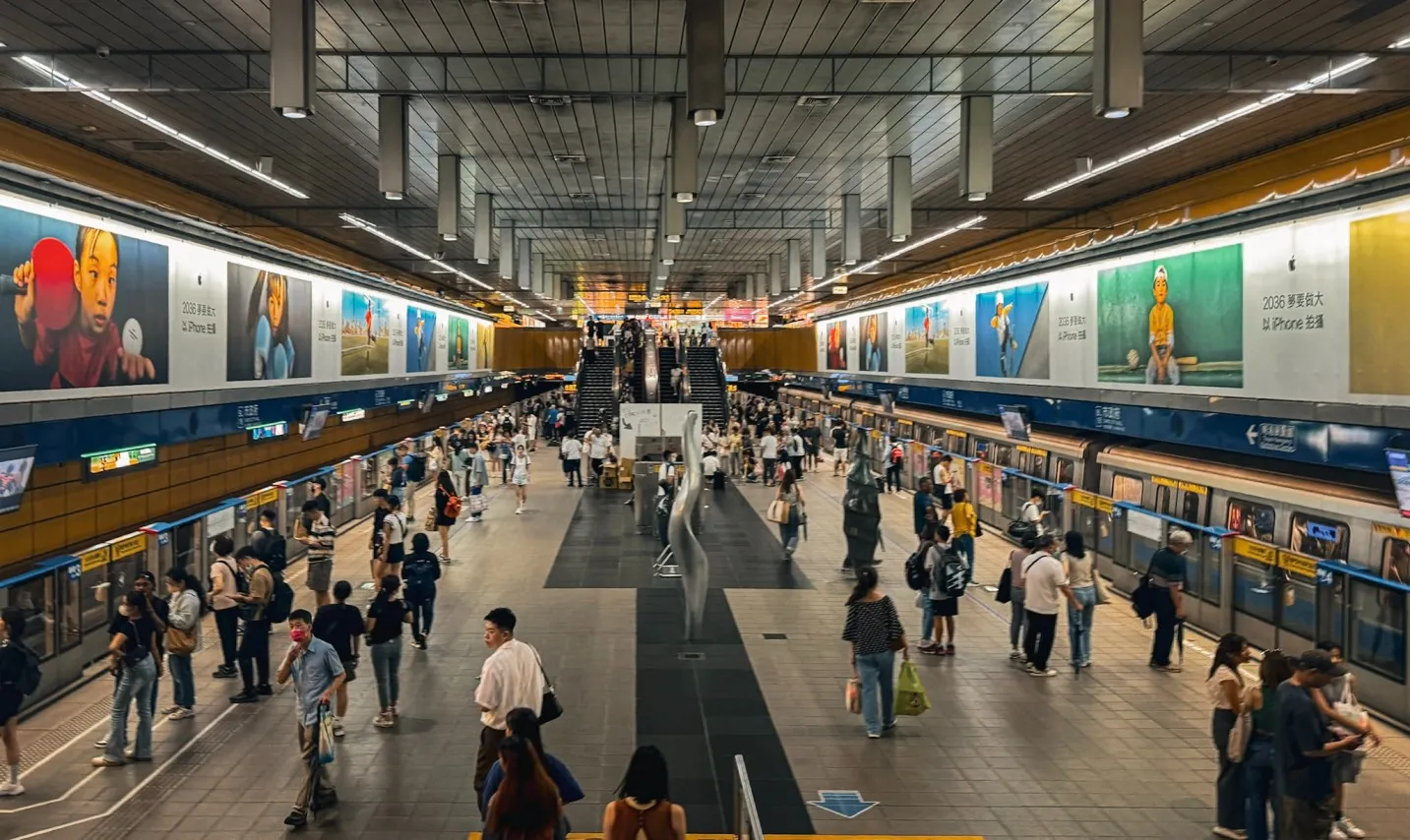
MRT
Taiwan has a metro system in 4 different cities: Taipei, Taoyuan, Kaohsiung, and Taichung. Taipei is the largest, while the others are smaller they take you to all the main areas. It’s a very simple system to navigate thanks to the signs in English, frequency of trains, and it’s clean to the point of feeling new. It runs from around 6 AM to midnight (a bit later at weekends).
Tap your EasyCard at the gates and you’re set. Most rides cost NT$20–40, so you can cross most cities for the price of a coffee.
An important rule on Taiwan’s MRT is that absolutely no food or drink are allowed on the platforms or trains, and you can be fined from NT$1,500 to NT$7,500. This helps keep the system clean and pest free. As someone who loves to take a coffee on my morning commute, this was hard to get used to. You can take the stuff on, but you just can’t use it. I was surprised by how strictly locals adhere to it; every journey there’s always someone diligently holding their bubble tea, not taking a sip. Also, the pink “priority” seats stay empty even on a packed carriage, left for elderly or pregnant passengers.
Train
If you’re travelling to different areas of Taiwan the best option is a train. I travelled all around Taiwan on them. I found them to be comfortable and reliable.
There are two train networks and they do different things.
- The High Speed Rail (HSR / 高鐵) runs down the west coast and is the way to move between cities like Taipei, Taichung, Chiayi Tainan, and Kaohsiung. It’s the faster option with Taipei to Kaohsiung only taking 90 minutes to travel over 350 km. Tickets can be booked online through Taiwan High-Speed Rail website, 12go Asia, or the T-Express app.
- The regular train (TRA / 台鐵) is slower, but it goes everywhere the HSR doesn’t such as the east coast and smaller towns. If you’re heading to Yilan, Hualien for Taroko Gorge, or down to Taitung, this is your route. The scenery is coastal, although the journey is slower, time will pass quick looking out at the views from the window. There are a few different trains:
- Express: these are the fastest options look for Puyuma, Taroko and Tze Chiang
- Chu-Kuang: these are semi-express and run a little cheaper
- Local: this is the cheapest and slowest option.
Book TRA tickets through their official website, 12go Asia or app “Taiwan Railway e-booking”, up to 28 days in advance.
Not all trains accept EasyCard as payment. The trains that allow it are: Tze Chiang (except TC3000), Chu Kuang and all local trains. You just won’t be able to book a seat in advance, but it gives you excellent flexibility.
Bus
If you have the time and on a tight budget. Operators like Kuo-Kuang and U-Bus connect every city you’d want to visit, often with reclining seats and free water on the longer routes. They’re much slower than the HSR which can get you to Kaohsiung from Taipei in 90 minutes, the bus takes almost 9 hours.
The easiest way to book long distance buses in Taiwan is through Busbud or 12GoAsia.
Local city buses are fine, but in Taipei and Kaohsiung you’ll mostly use the MRT as it’s just faster. I only used the local bus in Tainan.
Taiwan Tourist Shuttle also covers routes with the country’s biggest attractions such as Beitou hot springs, Jiufen, Daxi Old Street, and Lion’s Head Mountain.
Driving
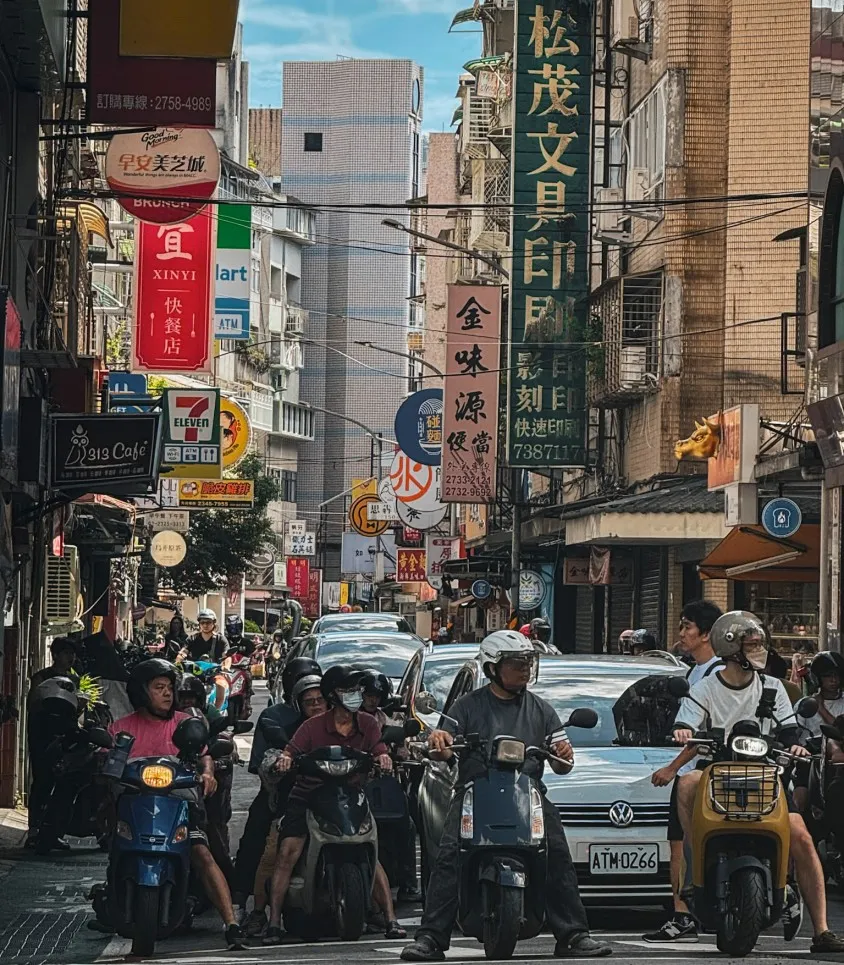
You can rent a car with an international driving permit, plus a Taiwanese add-on you can sort out at the airport. Driving makes sense if you’re tackling the east coast, the mountains, or anywhere outside the main HSR corridor. It’s worth noting that Taiwan favurs scooters to cars. They are everywhere.
You need to know what you are doing here in order to drive. My advice is if you’re just hopping between cities, skip the rental and take the train. If you’re going across the country to smaller islands or coastal towns then a scooter is a good idea. You’ll need an international license that covers motorcycles and appropriate travel insurance (not all cover scooters). Really, I’d only attempt it if you’re already confident on a scooter.
How Expensive Is Taiwan?
Taiwan is surprisingly affordable. Taipei runs pricier than Tainan or Kaohsiung, but the gap is mild. What’s great about Taiwan is the range of options. A sit down meal at a trendy restaurant can cost upwards of NT$500- NT$800 per person or an evening at a night market can be done for NT$300. Both are delicious, but one is much cheaper. Convenience stores are on every corner, where you can find a cheap and tasty snack. My favorite are beef noodle joints, where a bowl can easily fill you for hours.
Splurge on a night at a hot-springs hotel in Beitou or Jiaoxi, a slow afternoon at a teahouse up in Jiufen, and a few days on the east coast in Hualien’s Taroko Gorge.
Backpacker
Hostels in Taipei are cheap and weirdly clean. Night markets cover dinner, the MRT and YouBike cover everything else. Easier here than almost anywhere in East Asia.
Mid-range
A real hotel with a window, two sit-down meals, the High-Speed Rail down the island. This is what most people actually spend, and it gets you a great trip.
Comfortable
Design hotels, hot-springs nights, omakase, drivers for the day. You stop noticing prices because the prices were never going to hurt you anyway.
When To Visit Taiwan
Subtropical and damp. Long, drizzly winters under the northeast monsoon. Hot, humid summers. Grey for weeks at a time from November through March.
Properly tropical. Dry, sunny winters — beach weather often holds into December. Hotter summers than the north, but a lot more sunshine across the year.
Yangmingshan cherry blossoms in late February into March, then mild, mostly-dry weeks before the plum rains arrive. Mid-March to mid-April is the sweet spot island-wide. After that the north greys over for the long monsoon hand-off, while the south stays bright a little longer.
Plum rains run late May into June, then it’s typhoon season stacked on top of 33–35°C heat. Humidity stays around 80% whether the sun is out or not — there’s no escaping it at sea level. Locals retreat to Alishan, Hehuanshan, the east coast. Don’t try to do Taipei in July unless suffering is part of the trip.
When the island peaks. The heat finally lifts, typhoons largely move on, and the sky stays clear for days at a time. It’s still humid — Taiwan is always humid — but a totally different, walkable humidity. Late October through mid-November is the window everyone in the know aims for, north and south.
This is when north and south split into different countries. Taipei goes grey and drizzly at 14°C; the south hits its dry season — Tainan and Kaohsiung sunny, Kenting still warm enough to swim. So: south for sun, north for hot springs in Beitou or Jiaoxi. Skip Lunar New Year week, when half the country is on the move and a lot of small places shut.
Go mid-October to mid-November. The heat is finally walkable, typhoon season is over, and you can do the cities by day and the night markets after dark without writing the trip off as a sweat-through.
The one to avoid: July and August — peak typhoons stacked on peak heat. If you must come in summer, head straight for the mountains or the east coast and stay there.
Taiwanese Food: What To Eat in Taiwan
I didn’t expect to fall this hard for the food when I landed in Taipei. Taiwanese cuisine flies under the radar, overshadowed by the food scenes of its neighbors, China, Japan and Korea. Taiwan’s food is bold. Things that you would never think go together just do. For example they have created a sausage bun from sticky rice, where the sausage fat melts into the rice creating this chewy yet soft sensation. Or, stinky tofu, which sounds awful but once you get past the funky smell you’re left with crispy tangy pillows which spill out a sour sauce, well balanced by the pickled cabbage on the side. And then when you are searching for a dessert the peanut ice cream roll is not what you expect. Earthy taro ice cream on a bed of crushed peanut brittle, sprinkled with cilantro and wrapped in a thin wheat flour crepe. After the first cautious bite, this combination makes sense. Food streets like Yongkang Street in Taipei are the perfect place to explore the cuisine.
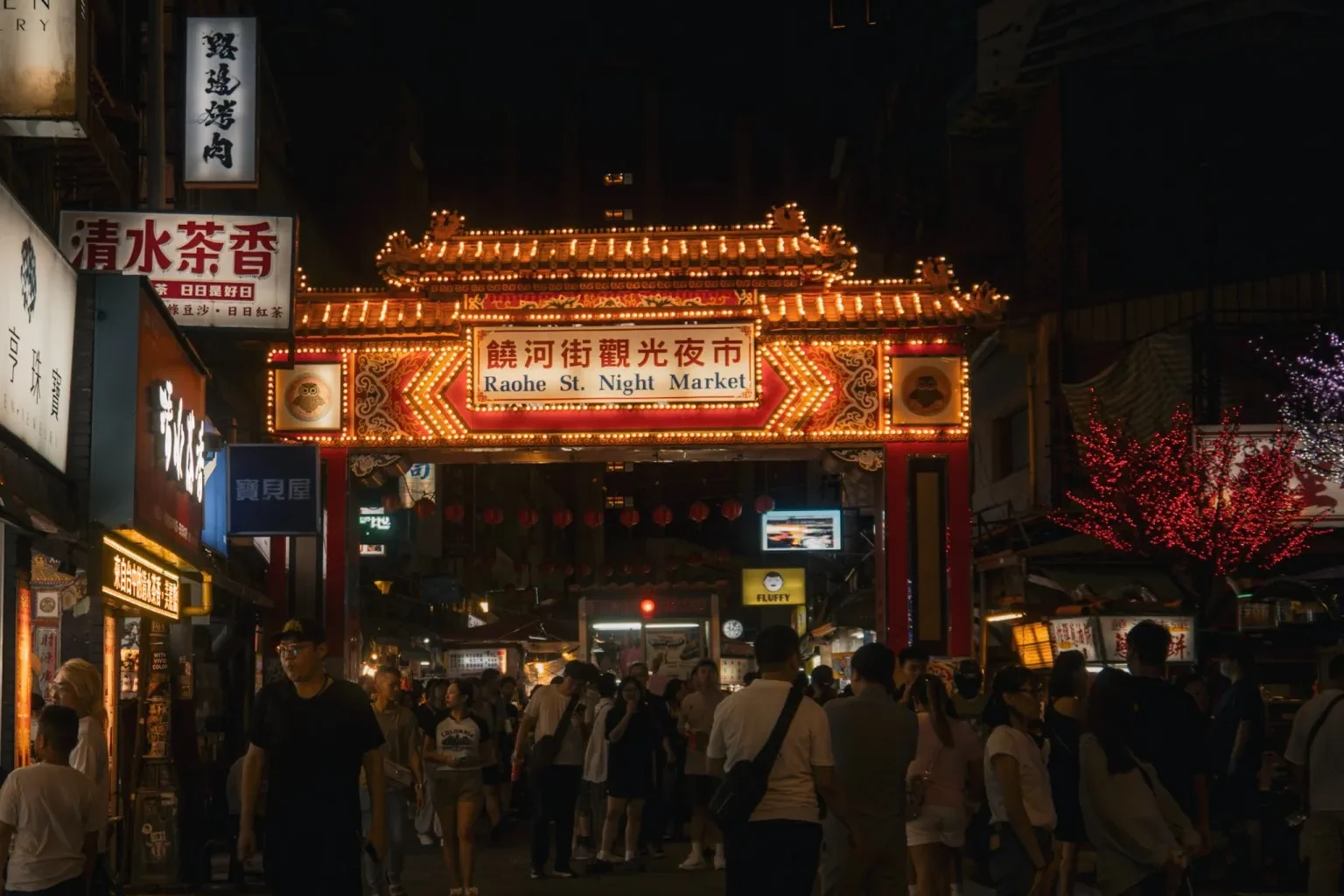
Influenced by a 50 year Japanese occupation and the wave of mainland Chinese who arrived with the KMT in 1949, there is a huge variety here. Japan left sushi, oden, beer, bento culture, while the KMT brought beef noodles, dumplings, and northern Chinese flavors. The heart of Taiwanese cooking is at the night market. You’ll find them all over the country, and they’re a huge part of the culture. Raohe and Shilin in Taipei, Ruifeng in Kaohsiung and Feng Chia in Taichung, are some of the country’s most well known night markets. Although you can find clothing stalls, it’s all about the food. Hop from stall to stall through a cloud of smoke and steam that carries the warm aromas of sausages that are cracking away on a grill.
As well as night markets, breakfast is one of the most important meals of the day here. Locals queue up at breakfast cafes from 5 AM to 11 AM. Try the egg crepe (dan bing), which is the unofficial national breakfast. Popular breakfast items are soy milk, rice rolls and turnip cakes.
Menus are mostly in Mandarin, but I always got by just fine with Google Translate. And as a last resort, pointing at the food gets you what you want.
Taiwan is also surprisingly vegetarian friendly. This is largely due to 13% of the population being Buddhist. Scallion pancake, stinky tofu, shaobing and chive dumplings are all vegetarian and so delicious.
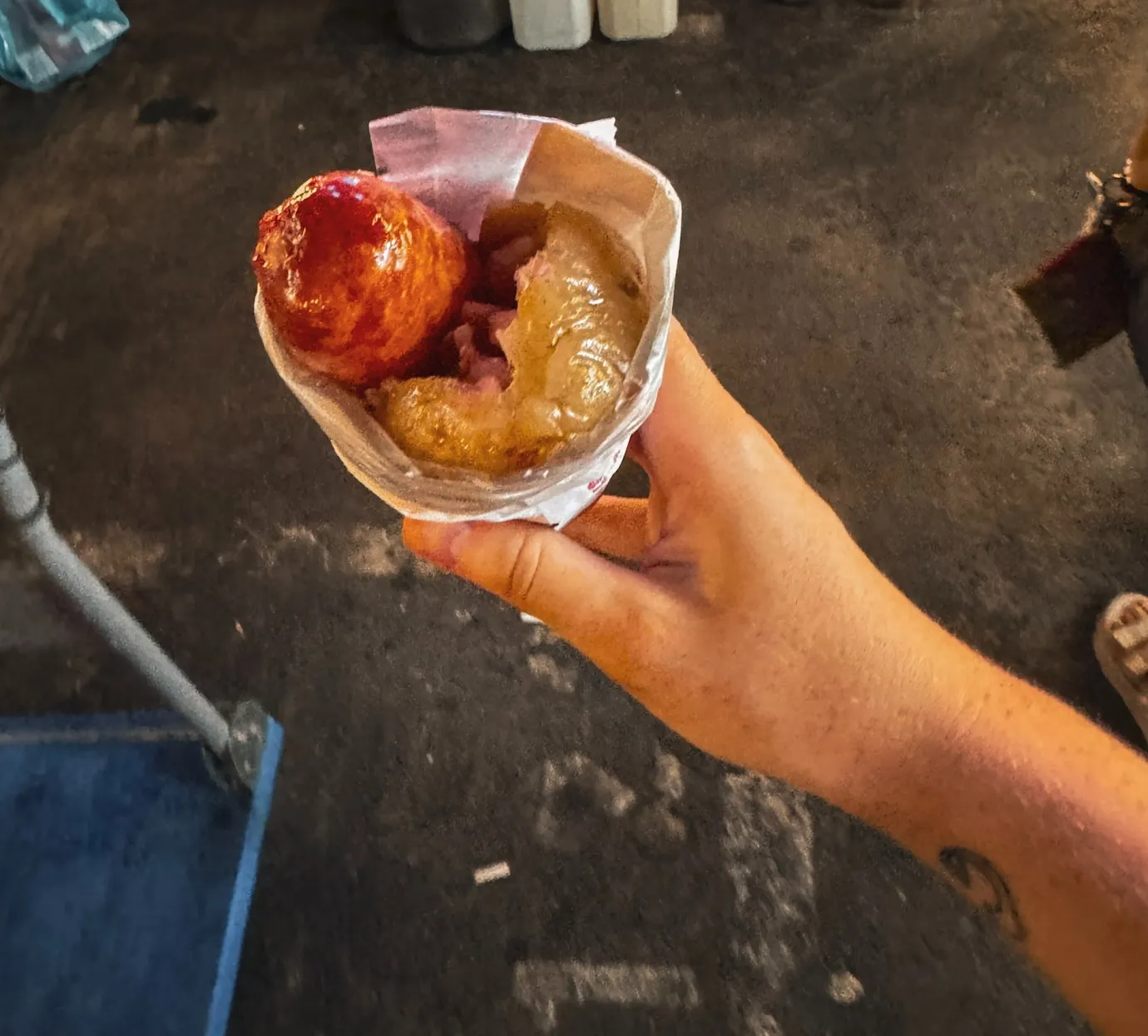
A grilled Taiwanese pork sausage tucked inside a fatter, hollowed-out glutinous rice sausage, then loaded with pickled mustard greens, raw garlic and basil. The literal name — 大腸包小腸, “big sausage wraps small sausage” — tells you exactly how seriously Taiwan takes its food puns.
Street food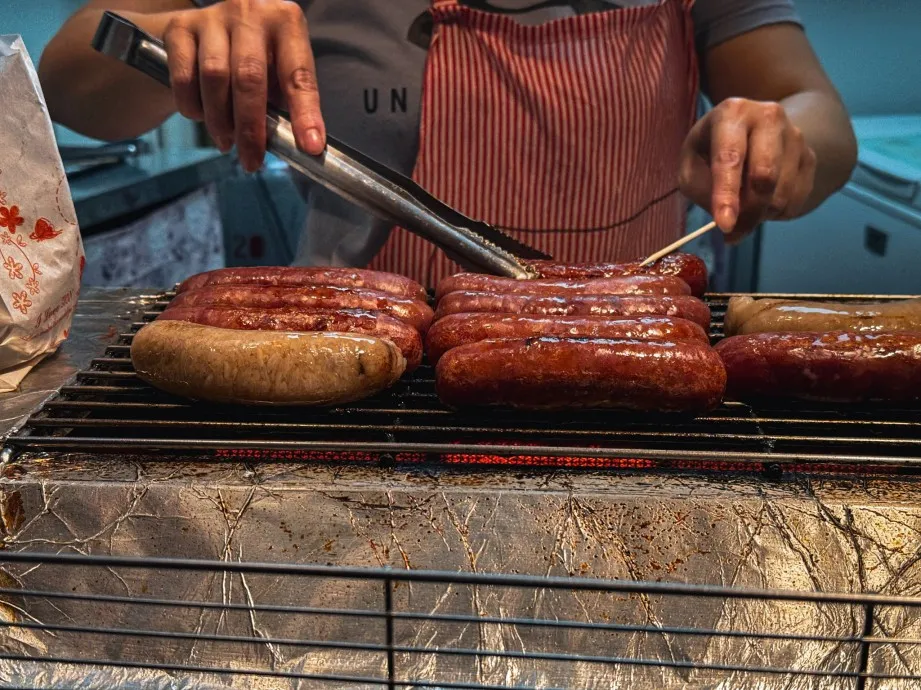
Sweet, smoky, slightly chewy pork sausage grilled over charcoal until the casing snaps, served on a stick with a single peeled clove of raw garlic on the side. The drill is: bite of sausage, bite of garlic, bite of sausage. Strange the first time. Perfect by the third.
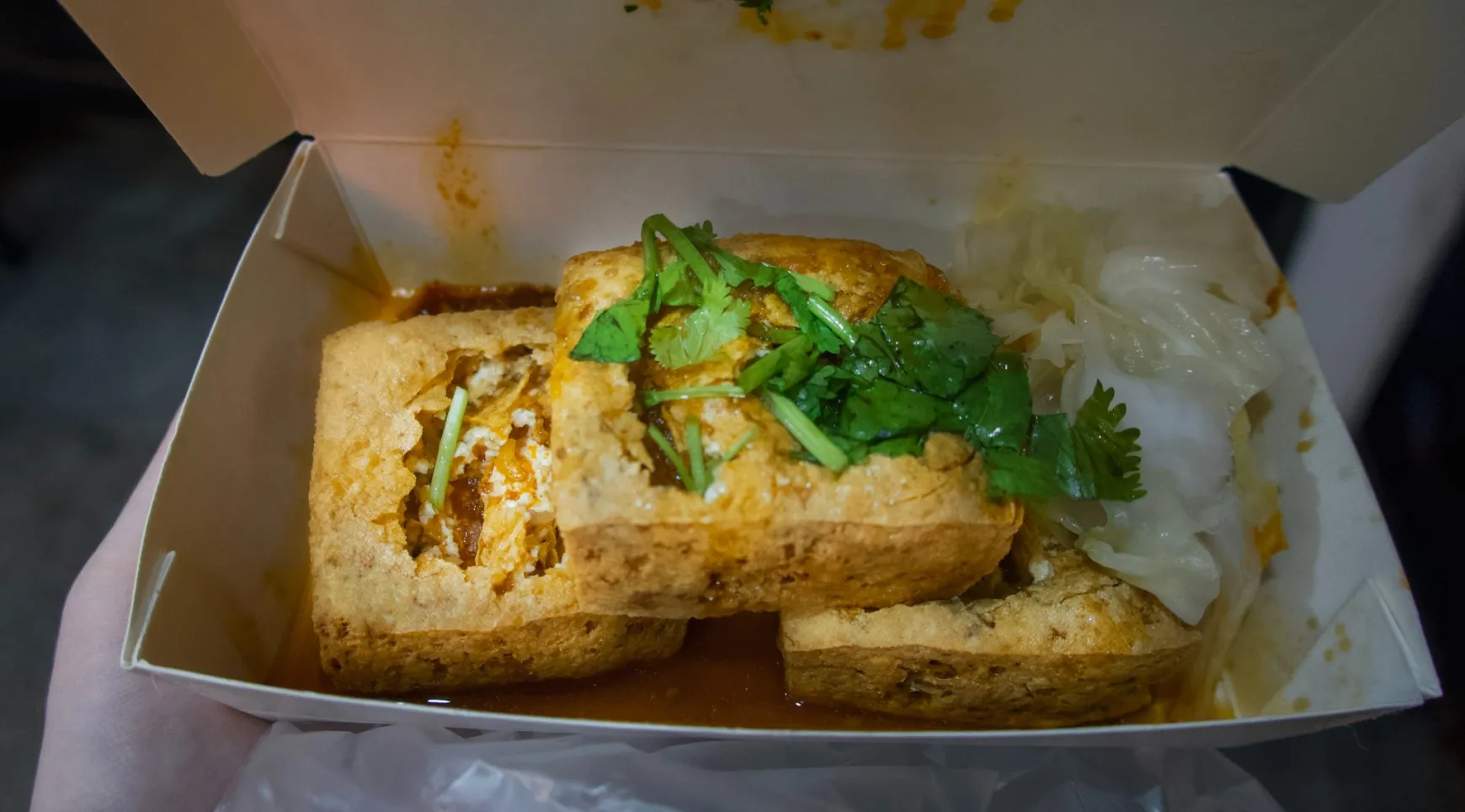
Fermented tofu deep-fried until the outside crisps and the inside turns custardy, served with pickled cabbage and a chilli-soy ladle. The smell is genuinely confronting — sour, funky, like a wet barn at the end of a long week — and the taste is none of those things. Taiwan’s truest dare. You’ll order it twice.
Don’t skip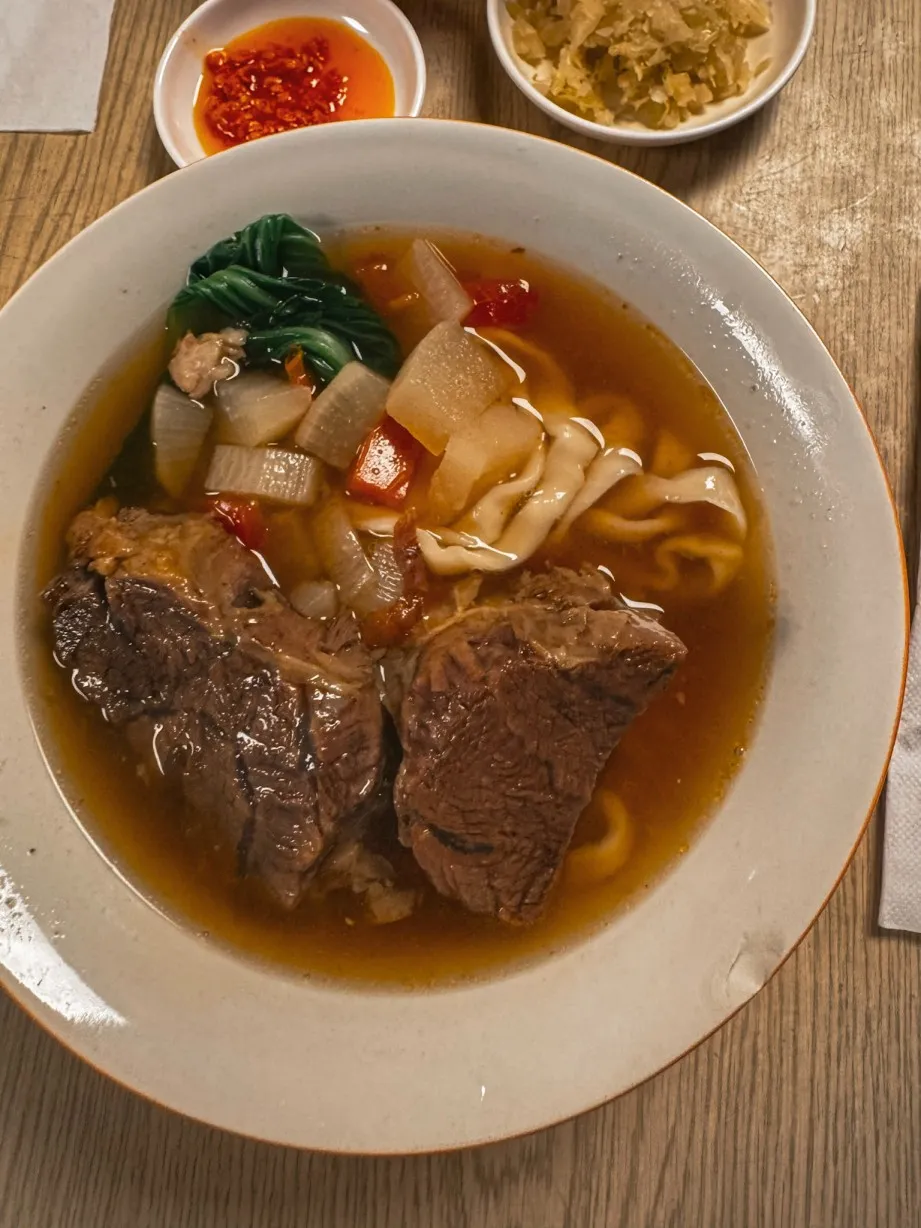
Hand-pulled noodles in a deep, soy-and-spice braised broth, with chunks of stewed shin and tendon collapsing into the soup. Brought to Taiwan by mainland veterans after 1949 and made distinctly Taiwanese here. The clear-broth (清燉) and red-braise (紅燒) camps will not agree about which is correct. Taipei has an annual festival ranking the best.
Must order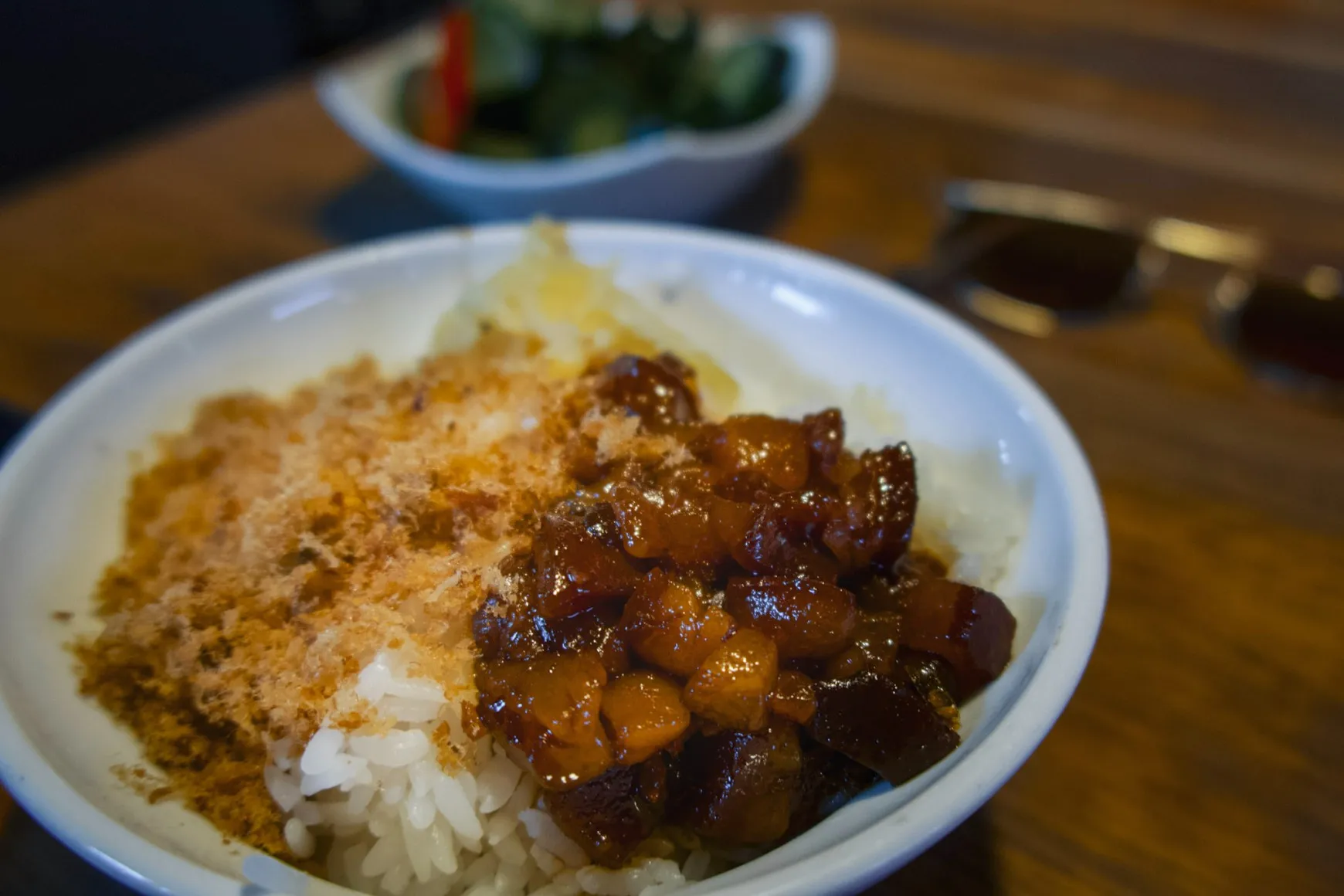
Minced pork belly braised low and slow with soy, rice wine, five-spice and chunks of rock sugar, then ladled glossy and dark over hot rice. NT$40 a bowl at a corner shop. The best version is probably the one nearest your hotel. Note: south of Chiayi the same name often gets you chunks of pork instead of mince. Both are right.
Must order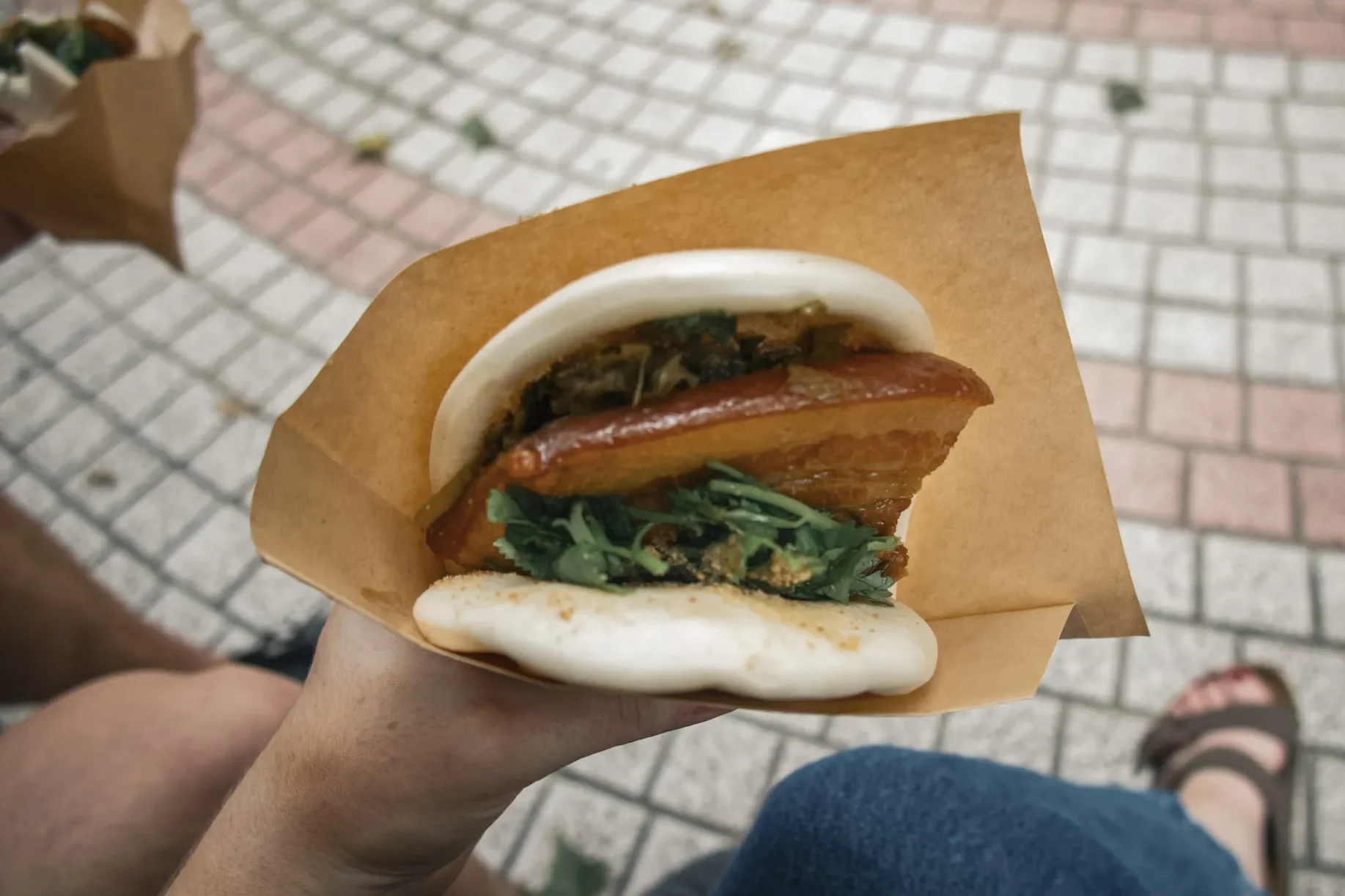
A pillowy folded steamed bun cradling slow-braised pork belly, pickled mustard greens, crushed peanut powder and a little cilantro. Sweet, salty, sour, herbaceous, all four corners hit at once. Sometimes called the Taiwanese hamburger by people who have clearly never had either.
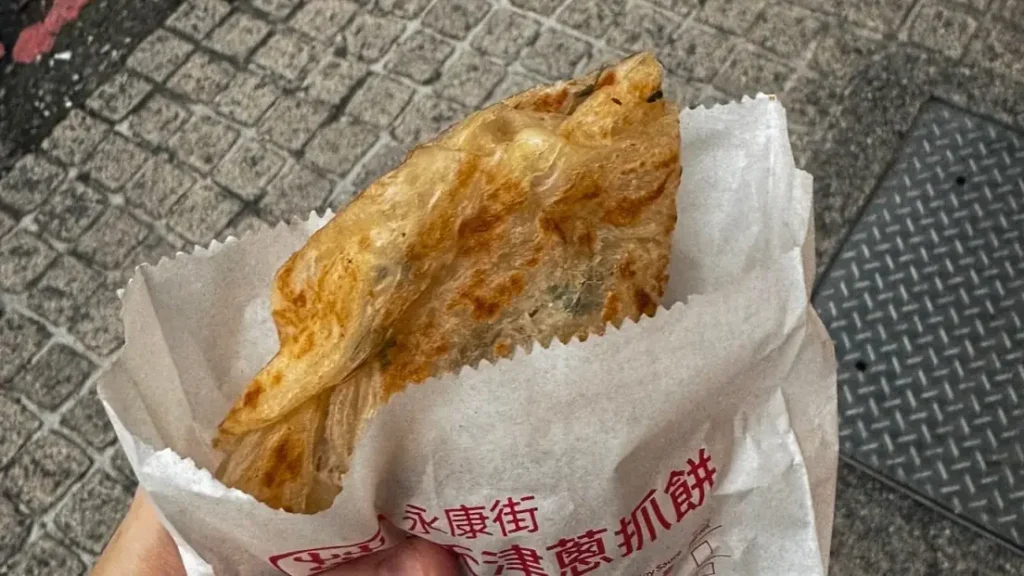
Lamination, but Taiwanese: chewy dough rolled with scallions and pan-fried until the outside crisps and the inside flakes apart in oily layers. Often with an egg cracked over the top and a smear of garlic-soy. Eaten walking, before 9 AM, from a cart with a queue.
Quick lunch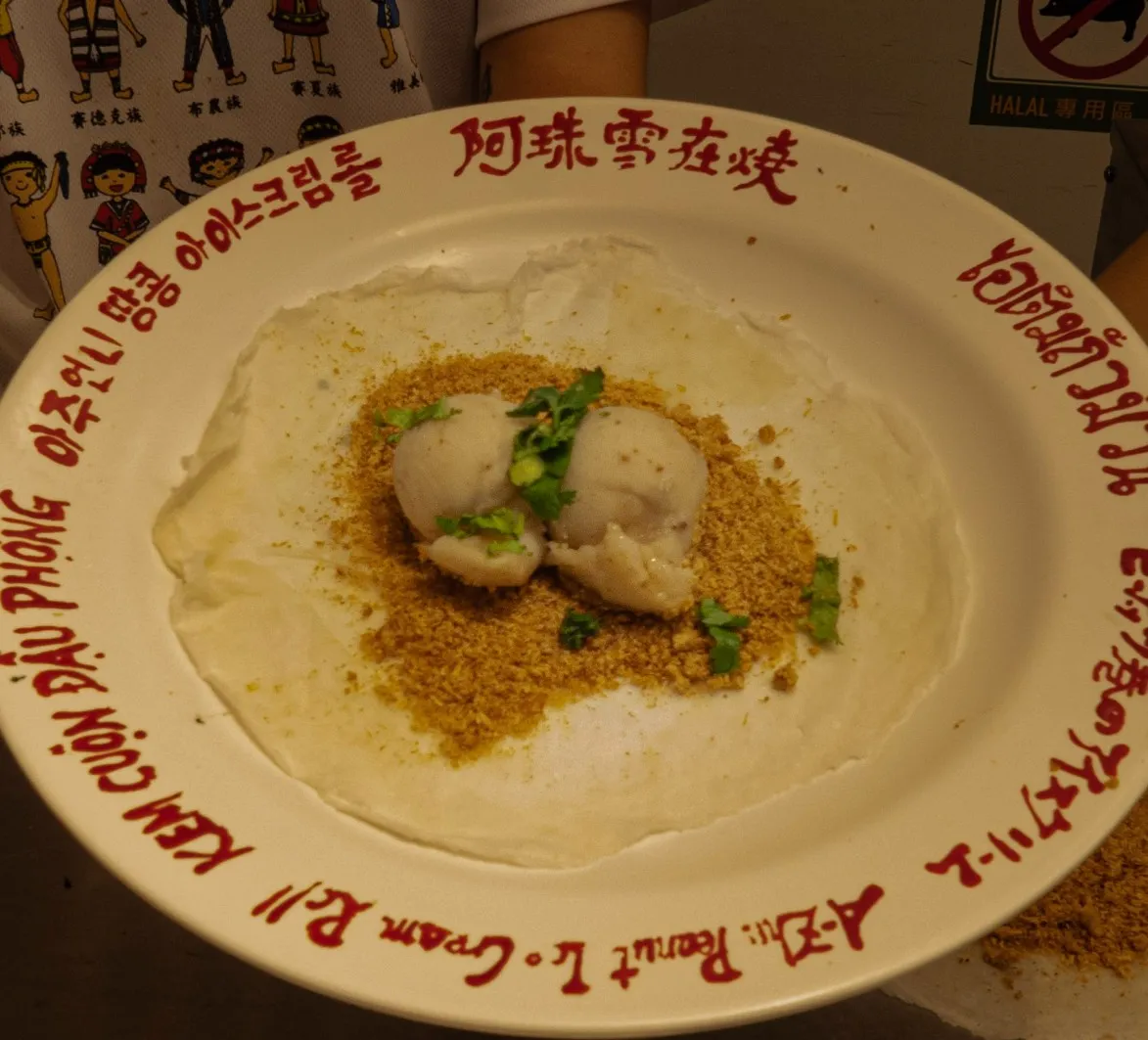
A thin spring-roll wrapper, two scoops of taro or peanut ice cream, peanut brittle shaved into curls over the top with what looks like a wood plane, and — yes — a handful of fresh cilantro. The combination should not work. It does. Cold, crunchy, herbal, unmistakable.
Don’t skip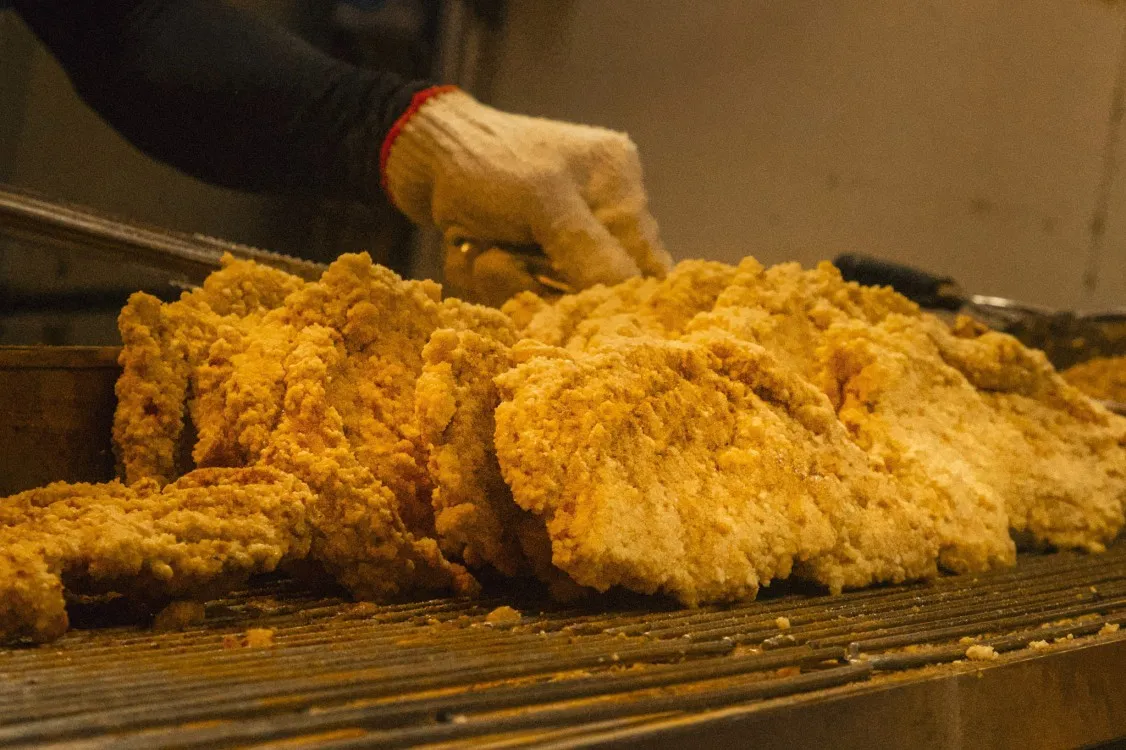
Two versions, both essential. The face-sized cutlet (大雞排, jī pái), butterflied flat, dredged in sweet potato starch and fried until crackling. And the small popcorn-style 鹹酥雞, salt-pepper bites tumbled with crispy basil leaves. Shilin Night Market is where the giant cutlet became a national event.
Street food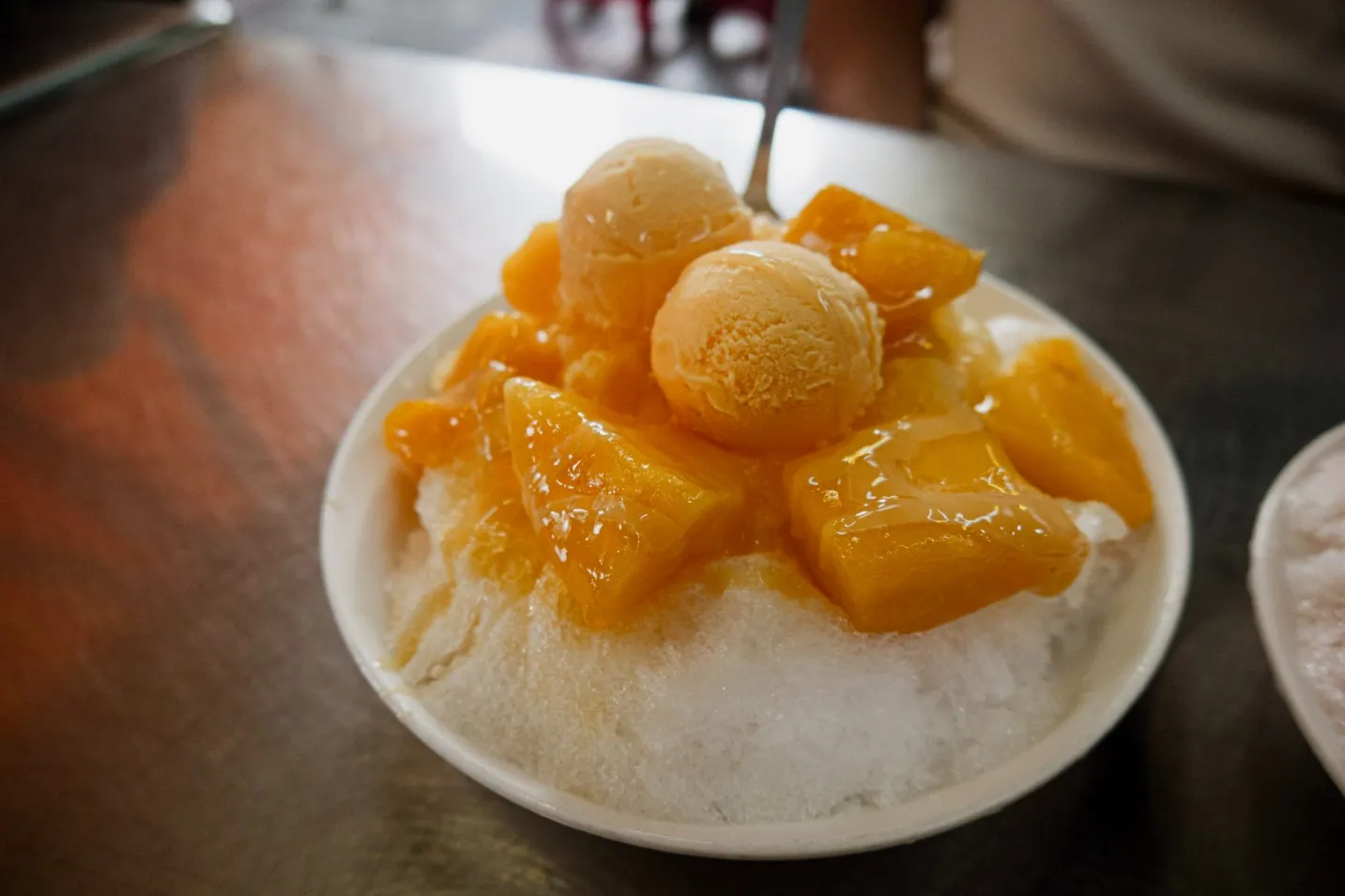
Snow-fine shavings of milk-flavoured ice, towered absurdly high, drowned in fresh mango chunks, mango syrup and a scoop of mango sorbet on top. Eaten in 33°C heat at a sidewalk table. The Tainan versions are more old-school and usually better than the Taipei ones, but Yongkang Street in Taipei is no embarrassment.
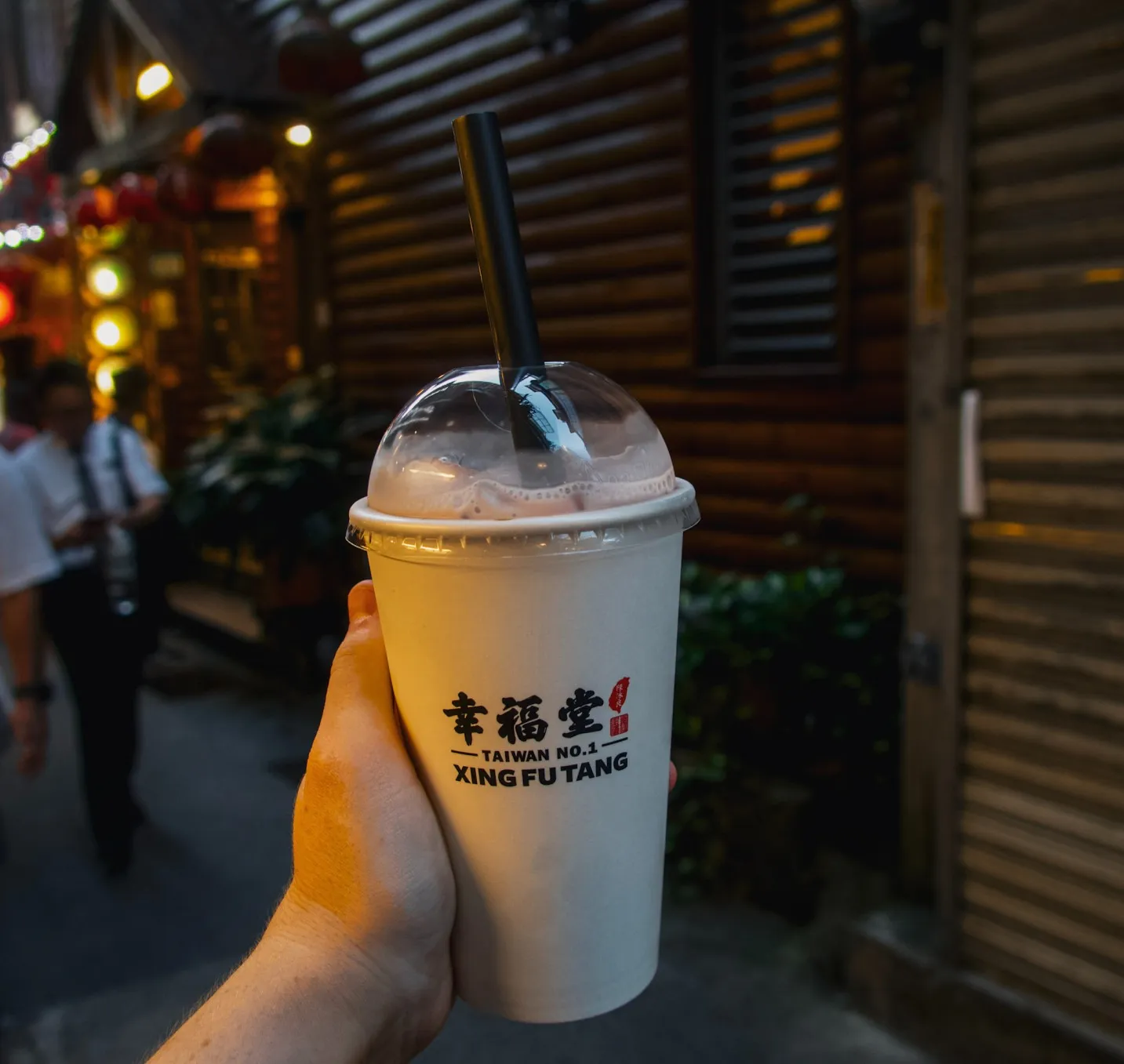
Cold milk tea shaken with ice and chewy black tapioca pearls cooked until just yielding, drunk through a fat plastic straw that’s somehow part of the experience. Invented in Taichung in the early 1980s — Chun Shui Tang and Hanlin Tea Room both claim it, and they argued about it in court for ten years. The original is tea-forward, lightly sweet, and the pearls actually taste of brown sugar. Most of what’s exported now is sugar-bomb knock-off; Taiwan is where you’ll see it as it was meant to be.
After dinnerSample Taiwan Itinerary
-
01
Taipei
Capital · the northStart in Taipei. It’s loud, dense, full of food smells, and where most people get their first taste of what Taiwan does well. Climb Elephant Mountain at sunset for the view of Taipei 101, eat your way through Raohe and Shilin night markets, and book a table at Din Tai Fung at least once. three days is the minimum. five is better. Read my detailed 4 day Taipei itinerary, made for first time visitors. Have less time? My 1 day itinerary takes you on a realistic whirlwind tour of the city
Stay 3 to 5 days -
02
Jiufen
Old gold town · northeast hillsAn old gold mining village in the hills an hour east of Taipei. Steep stone alleys, tea houses looking out to the sea, and red lanterns over the lanes once it gets dark. Most people daytrip out from Taipei, but it’s much nicer in the evening after the crowds leave. If you’re already this far out, the Pingxi sky lantern villages are a short drive further on. Don’t go without reading my 10 things to do in Jiufen based on my time there.
Stay 1 night, or a long day trip -
03
Hualien and Taroko
East coast · the gorgeThe east coast, where Taiwan gets wild. Hualien itself is a friendly small town you use as a base. The real reason you’re here is Taroko Gorge: marble cliffs hundreds of metres high, a turquoise river running through them, suspension bridges and tunnels carved straight into the rock. Hire a scooter if you’re confident, or join a half-day tour to see the best of it.
Stay 2 days -
04
Chishang
East Rift Valley · rice countryThe long valley between the mountains and the Pacific opens up into rice paddies that stretch as far as you can see. Chishang is a tiny town in the middle of it, famous for its rice and its train-station lunch boxes. Cycle out to Brown Avenue, a tree-lined road through the fields made famous by a 2013 coffee commercial, then eat the original Chishang lunch box (chí shàng biàn dāng) at the family shop by the station. It will reset your pulse.
Stay 1 day -
05
Kaohsiung
Southern coast · port cityTaiwan’s second city, sitting on a working harbour at the southern tip. Wider streets than Taipei, hotter sun, slower pace. The Pier-2 Art Centre fills old warehouses with galleries and bars, Liuhe and Ruifeng are two of the country’s best night markets, and the ferry across to Cijin Island is the cheapest fun you’ll have all trip. My complete guide to Kaohsiung can help you plan your trip.
Stay 2 days -
06
Tainan
Old capital · food obsessionThe oldest city in Taiwan and its former capital, half an hour north of Kaohsiung on the HSR. This is where you eat. Beef soup queues form before sunrise, danzai noodles arrive over slow-cooked broth, mango shaved ice ruins all other shaved ice. The temples and Dutch-era forts are worth a morning. Watching the sun set over Anping is non-negotiable.
Stay 2 days -
07
Alishan
Central mountains · tea countryUp into the mountains. Cool air, pine forests, high-mountain tea estates, and the famous sunrise above a sea of clouds. Take the old narrow-gauge train up to the village if it’s running. This is where the country goes vertical and quiet, and you’ll feel the air change the moment you start climbing.
Stay 2 days -
08
Sun Moon Lake
Central highlands · the lakeThe biggest lake in Taiwan, ringed with temples and cycle paths, sitting in the central highlands on your way back to Taipei. Spend a night, ride the lap around the lake (it’s about 30km, mostly flat), and slow down for one last evening before getting back to the city.
Stay 1 night
Taiwan Travel Guides
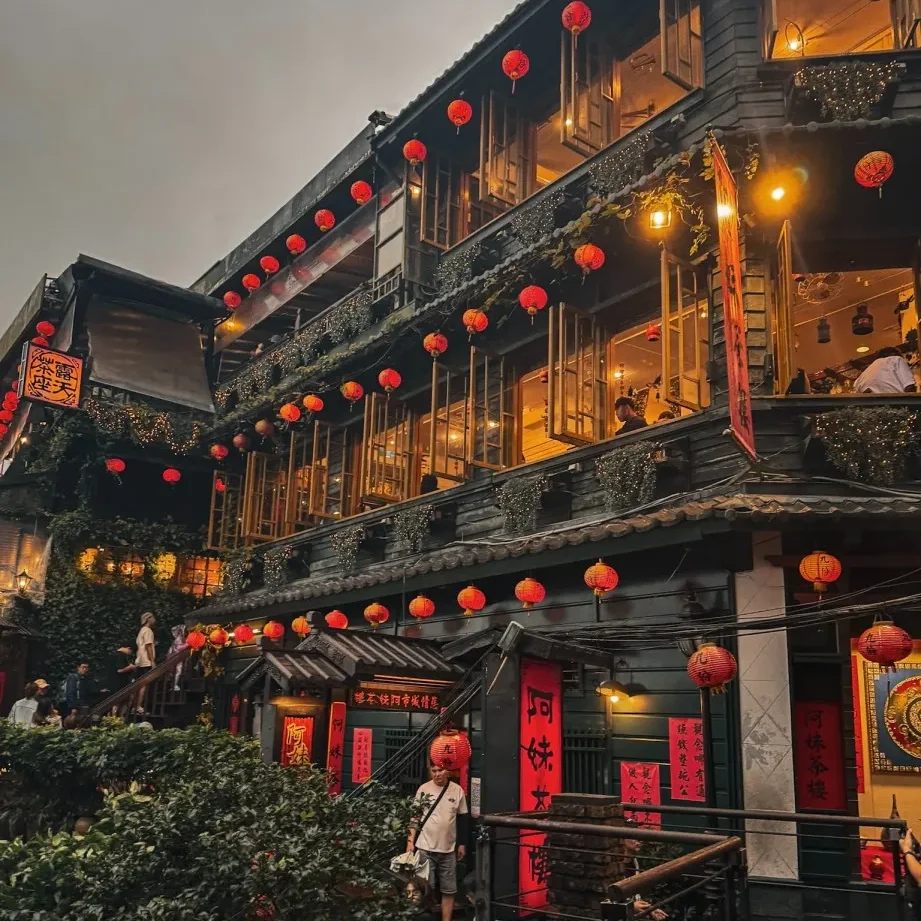
J I U F E N
K A O H S I U N G
T A I P E I
