
Chania might be a small city, but figuring out how to move around outside it and around Crete more broadly makes a real difference to your trip. You’ve essentially got three options: hop on the local bus network, which is surprisingly good for a city this size; grab a taxi when you want convenience and don’t mind paying a bit more; or rent a car if you’re planning to properly explore the island beyond what the buses can reach.
Each has its trade-offs, and which one suits you will largely come down to where you’re staying, how far you’re planning to venture, and how much patience you have for glitchy apps and QR code scanners (more on that shortly). Here’s everything you need to know to get around Chania, Crete.
Getting from Chania Airport
Chania Airport (CHQ) sits about 15km east of the city. It’s serviced by a KTEL bus so you’ve got two realistic options for getting into town.
The KTEL bus between Chania Airport and Chania bus picks up right outside the terminal and runs to the bus station in Chania city centre in around 25-30 minutes, depending on traffic. Tickets cost a flat rate of €2.70 regardless of zone, and you buy them online in advance or from a kiosk outside the airport.
Buses run fairly regularly during the day to match flight arrivals, but services thin out considerably in the evening, so if you’re landing late at night, check the timetable in advance rather than assuming there’ll be one waiting. The bus drops you at the central bus station, from where it’s a short walk into Old Town Chania.

If you’re arriving late, jet-lagged, or travelling with a lot of luggage a transfer might be the best option. There’s an official taxi rank right outside arrivals, and the fare into Chania centre is usually around €25-30, though this can be higher late at night or on holidays. It’s worth confirming the fare with the driver before you get in so you’re not caught off guard. You can also prearrange an airport transfer, where a car will be ready and waiting for you when you land, all paid in advance.
If you’ve booked a rental car, most of the major companies (including pickup for Discover Cars bookings) have desks inside the terminal. Check your confirmation email for exact pickup instructions, as this varies by provider. See the Rent a Car section below for what you’ll need to bring with you.

Need a place to store your bags before check in? Radical Storage allows you to safely store your bags while you explore
RELATED: Where To Stay In Chania, Crete (Areas & Hotels) →
Getting Around Chania: Your Options
Chania’s Old Town is small enough that walking is your best option for getting around day-to-day. The harbour, the winding lanes of the Venetian quarter and most restaurants, shops, and sights sit within a compact area that you can cross on foot in about 15-20 minutes. If you’re staying centrally, you likely won’t need the bus, a taxi, or a car at all for daily life. They only really come into play once you want to reach beaches, villages, or sights further out. And for that, these are your options.
Rent a Car
If you plan to see more of Crete than just Chania or where the bus take you, then driving is the way to go. You’ll have so much freedom to discover quieter beaches, small villages and experience a wilder side to the island. Discover Cars is always my go to for car rental, it’s easy to use, competitive prices and allows you to secure a good car in advance.
I wouldn’t bother renting a car if you plan to stay in Chania or your day trips are to places that the buses can easily reach like Rethymno, Stavros or Heraklion.
Prices start at €30 per day and a deposit of around €1,000, which will be charged as a hold on your card and released if no damage occurs. Companies will also lower the deposit to about €200 if you agree to pay a higher daily fee.
Make sure your insurance covers car rental as in the worst case scenario you can be liable for the full value of the car. If it doesn’t, Discover Cars allows you to add full coverage insurance for around €5 extra per day.
To rent a car in Crete you need an international drivers license if you have a non-EU license, along with 2 years driving experience on your license. The roads in Chania are fine, however traffic can be bad during the peak season. Greeks are also a little crazy on the roads, they drive fast and erratically. You’ll need patience, confidence and nerves of steel. Most rental companies do not allow you to drive to Balos Beach, as this involves off road driving with some big rocks sticking out of the ground which can easily burst your tires.
It’s also worth noting that parking in Chania centre is sparse, the carparks typically fill up fast so check your accommodation can provide a parking spot for you, as this is not a guarantee.
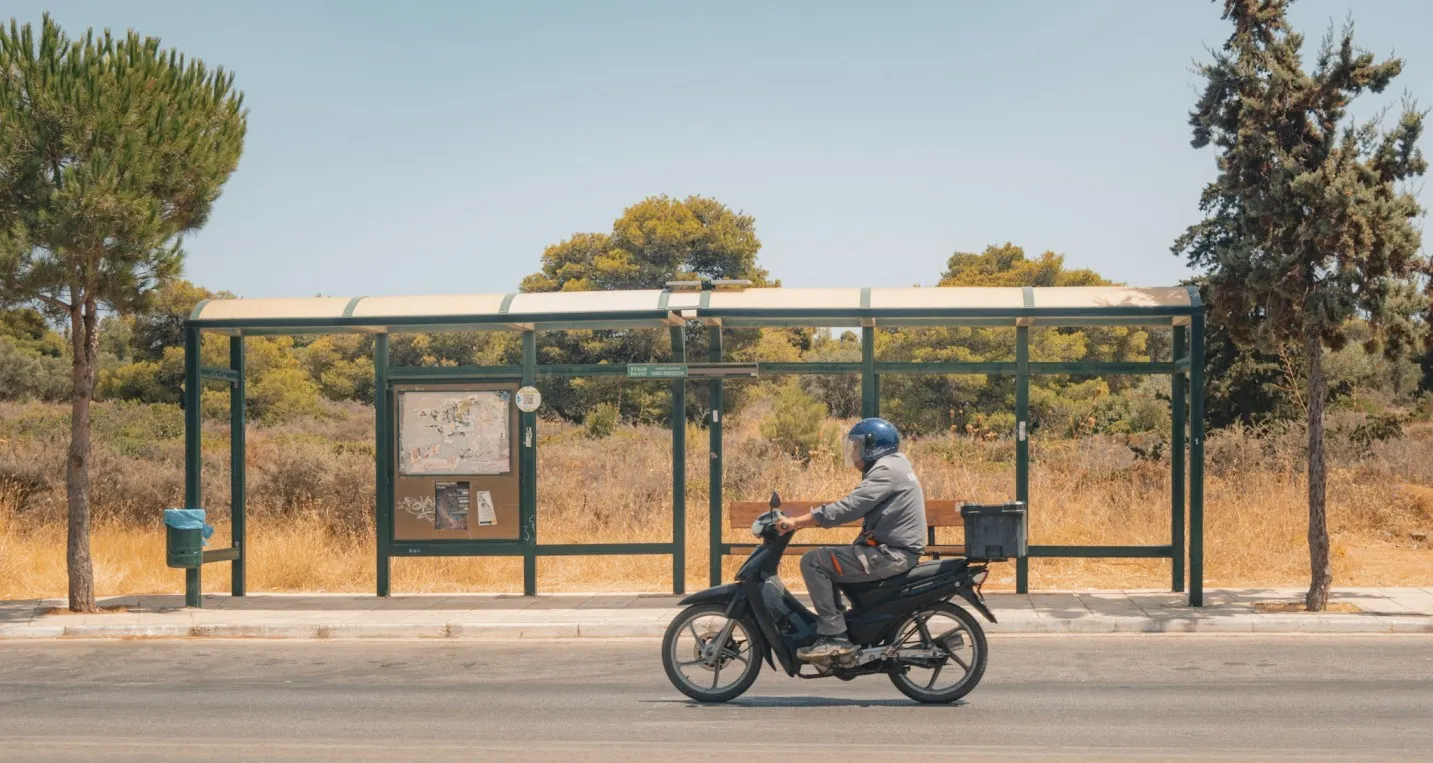
E-Bikes & Scooters
Renting a scooter or e-bike is a popular middle-ground option in Chania. There is more freedom than the bus, and are cheaper and easier to park than a car. Scooter rentals typically start from around €15 per day for smaller 50cc models, rising to €25-30 per day for more powerful options, and most companies include helmets and basic insurance in the price, though it’s worth checking exactly what’s covered before you sign anything.
For scooters, a standard car licence (category B) is usually enough for the smallest 50cc models, while slightly larger scooters require an A1 or A2 motorbike licence, check the specific requirement with your rental company before booking, as it varies by engine size. E-bikes are the more relaxed option if you’d rather skip the licence question altogether, and several companies in town offer both rentals and guided e-bike tours around the harbour and Old Town.
Both scooters and e-bikes sidestep Chania’s notoriously tight parking situation, since you can usually find space for them right in the centre where a car simply can’t fit.
RELATED: 24 Best Things To Do In Chania →
Bus
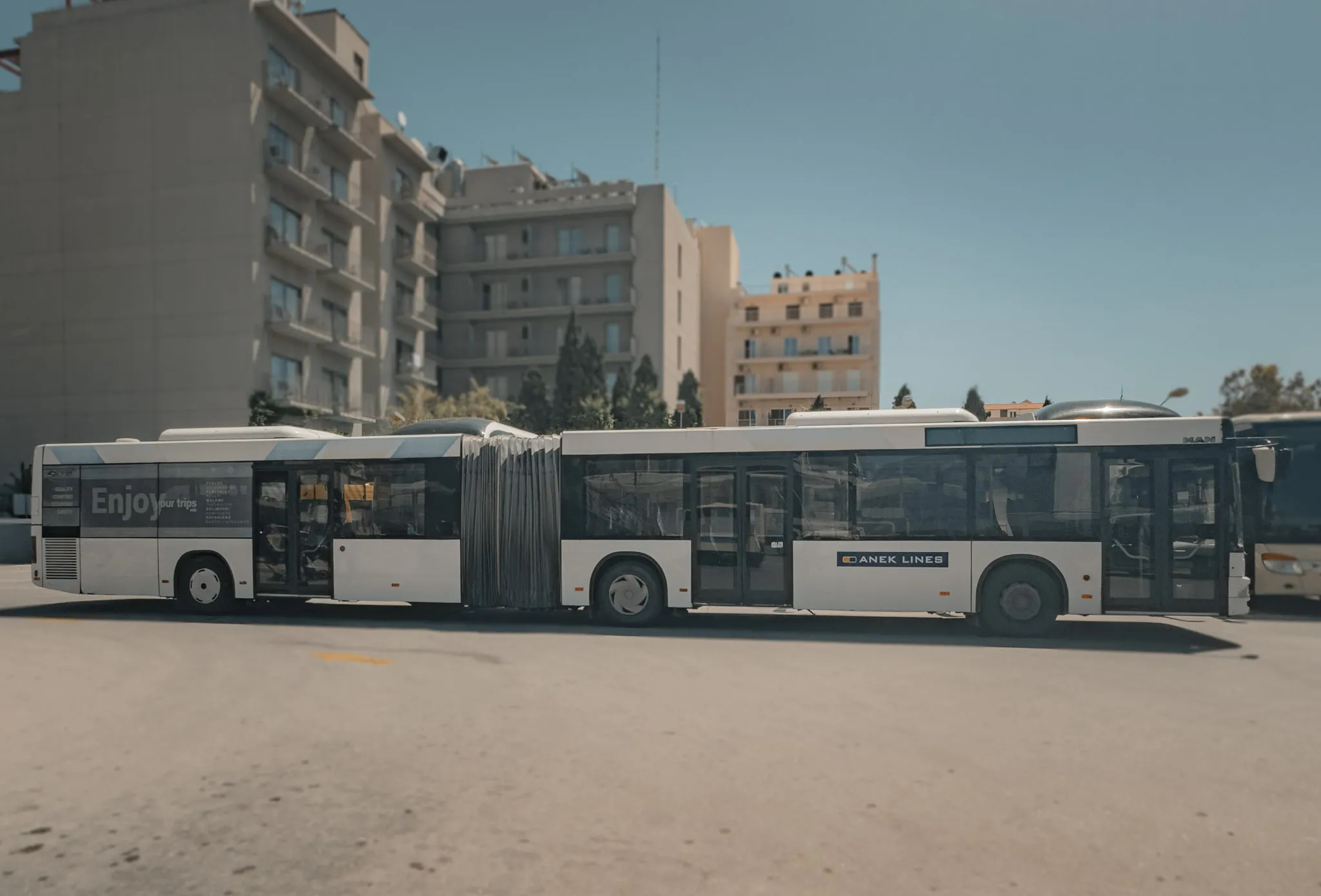
Chania has a terrific bus network, one that you typically wouldn’t expect from a city as small as Chania. There are 13 lines that take you around the city and its hinterlands. It goes as far as Agii Apostoli in the west and Kounoupidiana and Souda Bay.
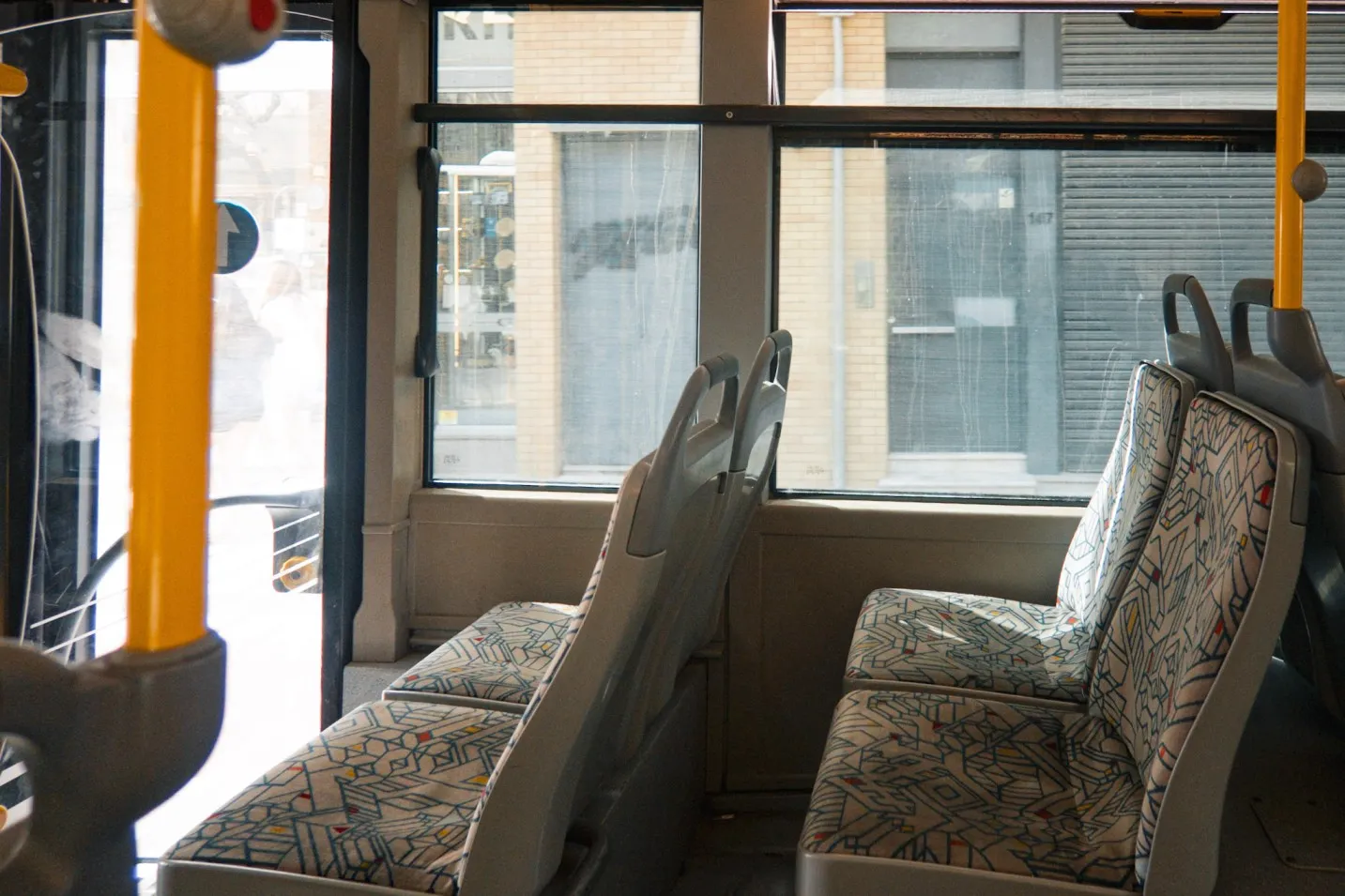
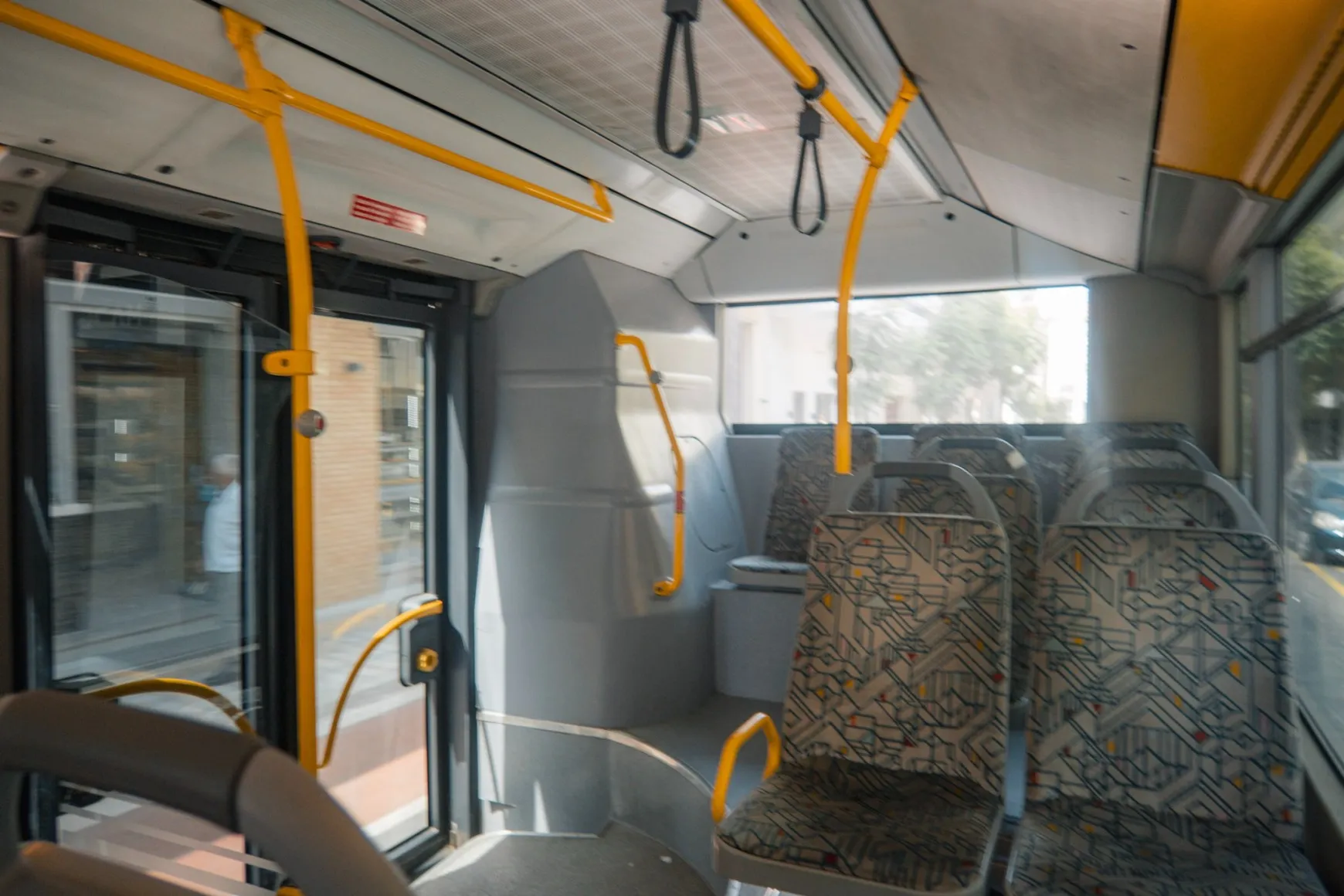
The buses are comfortable and modern, fitted with both air conditioning and WiFi. I found them to be an enjoyable, stress free option for getting around Chania.
Note: the city bus network doesn’t serve the airport. See the Getting From Chania Airport section above for the KTEL bus
Each bus stop has a QR code, which when scanned will tell you when the next bus is. I found the buses to be frequent – approximately every 15 minutes, but you can check the timetables here for your specific bus.
When the bus arrives you’ll need to stick your arm out to get the driver to stop. You then get on at the front door to purchase or show your ticket to the driver, and then depart through the middle doors when it’s time to get off.
Cost of Tickets
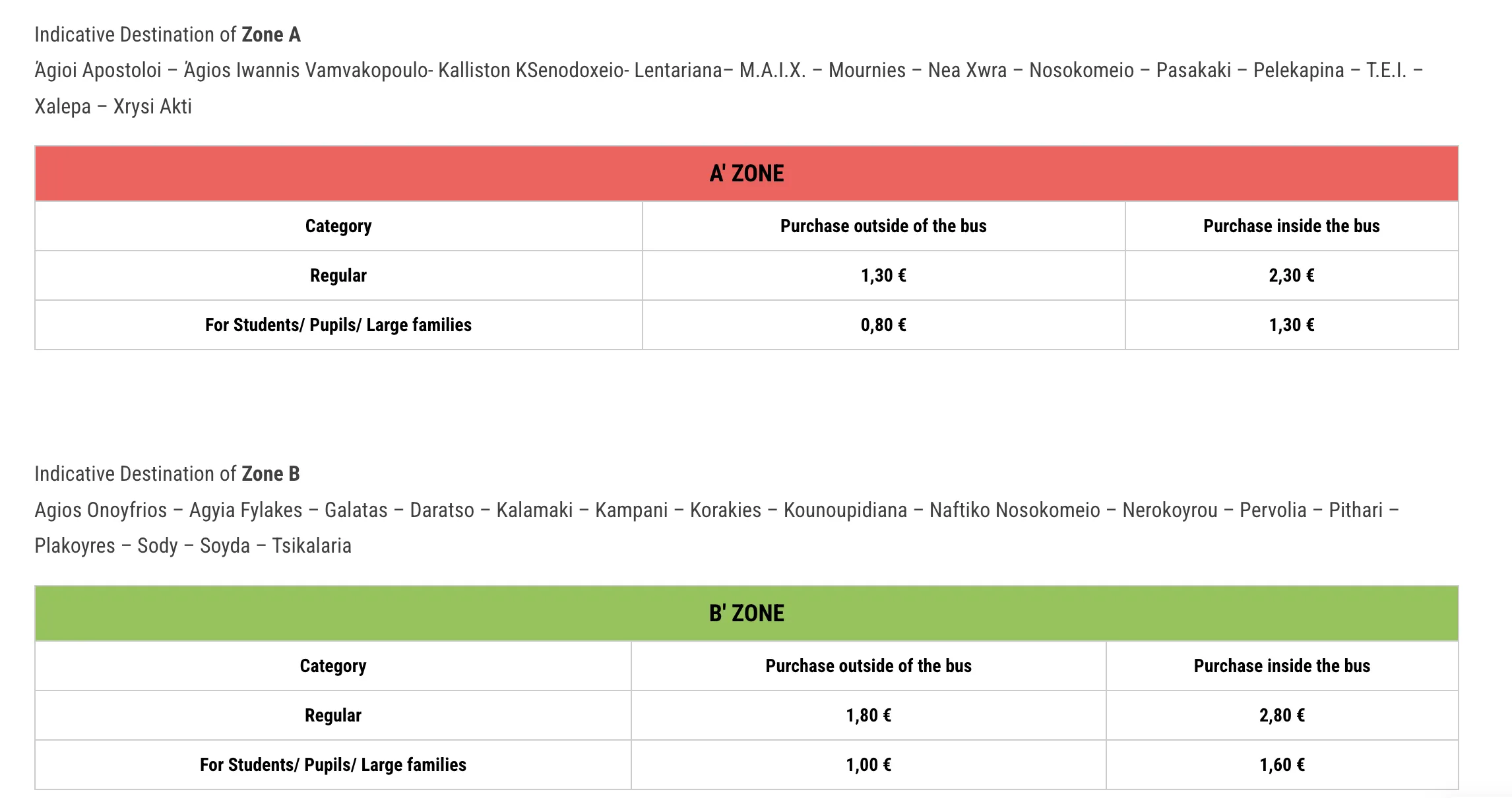
There are two zones in Chania. Zone A is pretty much Chania city while Zone B covers the neighbourhoods and beaches outside Chania.
Zone A has a flat charge of €1.30 per adult if purchased in advance or €2.30 if purchased from driver. While Zone B has a flat charge of €1.80 per adult advance purchase or €2.80 if purchased from driver. It doesn’t matter if you’re travelling for one stop or the full bus route, the charge will be the same regardless.
Chania Urban Bus Ticket Prices 2026
How to Purchase Tickets
There are a few different ways to get you Chania bus ticket either on board from the driver, through the official app or from a ticket kiosk / machine.
1. On Board – most expensive
This is by far the easiest way to buy a Chania bus ticket. You just need to state if you’re going to Zone A or Zone B, you can then either pay the driver in cash (notes are accepted) or simply tap your card/phone.
A small receipt will be printed, keep this as it’s your ticket. The only catch is at €2.80 it’s €1 more expensive than the other options, which although cheaper have their flaws.
2. Chania City Bus App – can be glitchy
Woohoo a bus app, how convenient I hear you say. HA HA don’t you know you’re in Greece, there’s gotta be a catch. This was initially my preferred way to get my ticket but a few awkward encounters made me ditch it. I’m already socially awkward enough, but this app made simple bus journeys a little painful for us awkward people.
Overall the app has a lot of potential, but in its current state it’s almost redundant. Buying the tickets is easy but it’s extremely difficult to scan the QR code on the bus. I’ll explain.
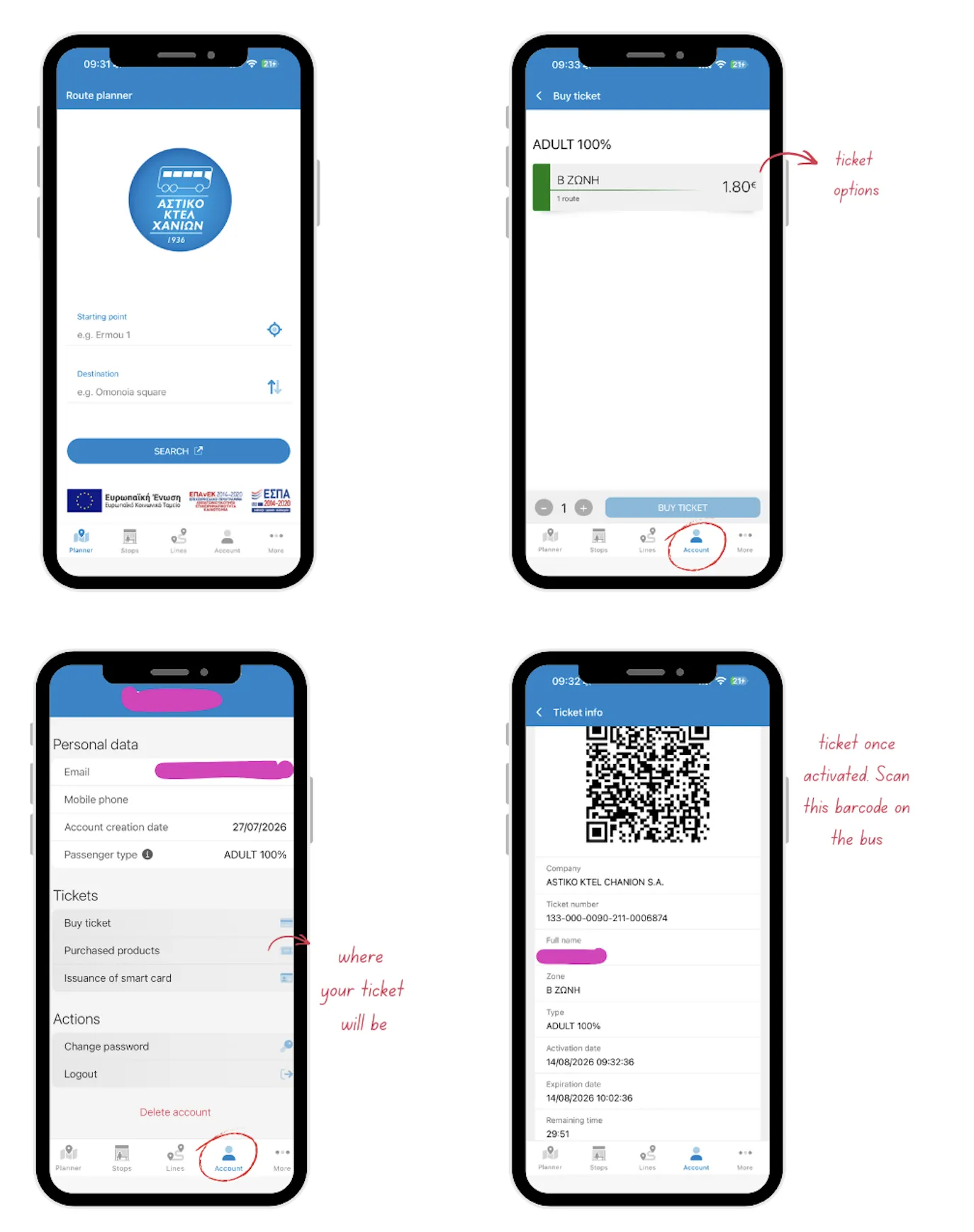
How to purchase a ticket from Chania Urban Bus app:
- Download the official app here
- Register an account and then activate it from your email
- Upload your credit card details under the account section of the app to enable purchases
- Under “my account” navigate to “buy ticket”
- Purchase a Zone B €1.80 ticket (currently no option for a Zone A €1.30 ticket)
- Go to my account -> purchased products to find your ticket
- Click on ticket to activate it (only valid for 30 mins once activated so only activate it when the bus is pulling up)
RELATED: 17 Must Try Foods In Crete →
Once you activate the ticket a QR code will come up on the screen. You need this QR code to scan when you board the bus, this machine is beside the driver.
The problem is that these scanners are TERRIBLE at their one God given job. The laser is very small meaning you need to hold your phone in a certain way for it to pick up the QR code. This can get frustrating when there’s a queue and the driver just wants to move on. It takes a lot of patience and manoeuvring your phone in different positions until you hear a very faint beep.
One time it just wouldn’t work, the driver got annoyed and told me to sit down (I don’t blame him), it meant I rode for free. But who wants to be the passenger that irritates the bus driver.
Aside from purchasing a ticket you can also check bus stops and bus lines. I found the nearest bus stop feature very useful which showed me the distance of the nearest bus stops and lines.
The app is pretty glitchy, I couldn’t use the map functionality or the route planner on the home screen. Hopefully they improve this in the future and it’ll be a great little app.
3. Ticket Office or Automated Machine – great if you’re staying near a ticket seller
There’s something so whimsical about buying a bus ticket from a ticket office or shop in Europe. It feels so old school. As charming as it may be, it’s not the most convenient, as it’s only certain shops that sell tickets, and you need to know where they are, which as a tourist it means you gotta do a bit of research first. However you also get the added bonus of the knowledge of the local shopkeeper if you are confused about what bus to get.
Tickets are also cheaper than buying onboard at €1.30 and €1.80 depending on zone.
There are also automated machines in the bus station and various other spots throughout Chania. Check this map with the locations of all ticket offices, kiosks, shops and automated machines.
Best bus routes for tourists
You probably won’t need to use the bus too much during your stay, I imagine if you do it’s to go to a beach in the west side like Golden Beach, Nea Chora Beach, or a scenic cafe like Koukouvaya in Halepa.
Bus number 21 is the bus most tourists use as it goes between Kalamaki and Ag. Apostoli, passing through Chania centre. You can reach the best beaches in Chania here. Bus number 18 will also take you to the archaeological museum of Chania.
For areas outside of Chania like Rethymno, Heraklion and Stavros you’ll need to purchase your bus through the KTEL website or buy them at Chania bus station. It’s a different system to the Chania Urban Bus, so the app won’t work.
RELATED: Best Beaches Near Chania Crete →
Taxi
Taxis are the third option, and honestly the most convenient if you’re short on time or travelling with luggage. Chania has official taxi ranks scattered around the city, including a large one at 1866 Square and another at the port, or you can flag one down on the street if its light is on.
Expect a starting fare around €3.50 plus roughly €0.75-€1 per kilometre, though this creeps up late at night and on public holidays thanks to a higher tariff rate. A short hop across the Old Town might run you €5-7, while the airport transfer typically costs around €25-30 depending on where you’re staying.
- 1866 Square (outside Carrefour Express)
- The National Bank (beside H&M) – you can also book online
- Across from Alegro Cafe on Apokoronou Street
Not all drivers use the meter with tourists, so it’s worth confirming “meter please” (or agreeing a fixed price upfront) before you set off. Uber doesn’t operate in Chania, but Beat, the Greek ride-hailing app, works well and takes the awkwardness out of negotiating a fare, as it’ll show you the price before you book.
RELATED: Chania’s Best Cafes →
